
The Trump trade shock is a chance to push long-overdue reforms, rather than tinker with tariffs to appease the US, suggests M Govinda Rao.

'It may be prudent not to plunge into a new online tax appeals system in one go, which could only create more disputes and increase the embarrassingly high tax arrears of the government,' warns A K Bhattacharya.

Reels often induce the FOMO-'Act now!' mentality. But sound investing is about consistency, diversification and a long-term horizon.
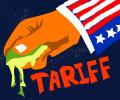
US President Donald Trump on Wednesday slapped an additional 25 per cent tariff on goods coming from India as penalty for New Delhi's continued buying of Russian oil.

Robert Vadra, husband of Priyanka Gandhi Vadra, appeared before the Enforcement Directorate for questioning in connection with the Sanjay Bhandari money laundering case.
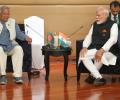
India has exempted Bangladeshi exports to Nepal and Bhutan as such trade facilitation is mandatory for landlocked countries under the framework of provisions of the World Trade Organisation (WTO).

Anticipating US action on tariffs, India seems to have made the first move by revamping its tariff structure by reducing the slabs to eight rates, points out Mukesh Butani.

So tell us, does Sitharaman's budget deserve cheers or boos?

Andhra Pradesh will establish two expansive integrated space cities in Lepakshi and Tirupati, spanning around 33,000 acres.

While indirect taxes collections have exceeded revised estimates (RE) by Rs 9,885 crore, direct tax realisations fell short by Rs 4,000 crore over the RE.
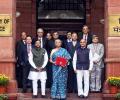
Finance Minister Nirmala Sitharaman on Thursday presented her sixth Budget in a row, equalling the record of former Prime Minister Morarji Desai.
Can this growth in GST collection be sustained in the coming years? asks A K Bhattacharya.

These are the highlights of the Union Budget 2025-26 presented by Finance Minister Nirmala Sitharaman in Parliament on Saturday.

In a recent clarification, the Central Board of Indirect Taxes and Customs (CBIC) provided insights into the goods and services tax (GST) treatment of transactions involving vouchers. According to the CBIC, vouchers can be categorised into two types.
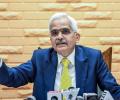
P K Mishra, a retired IAS officer of the Gujarat cadre, is currently serving as the principal secretary to the prime minister.

The Central Bureau of Investigation (CBI) has registered an FIR against an Enforcement Directorate (ED) assistant director who escaped during a trap operation last week. The ED officer, posted in Shimla, is accused of demanding bribes from promoters of educational institutes in Himachal Pradesh. The CBI has already arrested the officer's brother and a middleman in connection with the case. The ED officer and his supervisory officers have been transferred to Delhi.

It is important to clarify that availing of an exemption is neither evasion nor tax planning.

India's second largest IT services company Infosys has been slapped with a 'pre-show cause' notice for alleged GST evasion to the tune of about Rs 32,403 crore. In a BSE filing, the Bengaluru headquartered IT firm said Karnataka State GST authorities have issued a pre-show cause notice for payment of GST of Rs 32,403 crores for the period July 2017 to March 2022, towards the expenses incurred by overseas branch offices of Infosys Ltd, and added that the company has responded to the pre-show cause notice.
GST authorities have identified about 17,000 non-existent GSTINs and cancelled over 4,900 registrations in the ongoing pan-India drive against fake registration, a senior tax official said on Wednesday. Currently, there are 1.40 crore businesses registered under Goods and Services Tax, nearly double the number of businesses registered in indirect tax regime pre-GST rollout. Central Board of Indirect Taxes and Customs (CBIC) member Shashank Priya said in the drive against fake registration, till July 4, over 69,600 GST Identification Numbers (GSTINs) have been selected for physical verification by field tax officers.
Gross GST collections in August grew 10 per cent to about Rs 1.75 lakh crore, reflecting higher domestic consumption. As per the government data released on Sunday, gross GST revenues from domestic transactions grew 9.2 per cent to about Rs 1.25 lakh crore. Revenues from import of goods were up 12.1 per cent to Rs 49,976 crore.
Goods and Services Tax collections jumped 10.4 per cent to over Rs 1.72 lakh crore in January, reflecting buoyant economic activity and setting the stage for the next phase of GST reforms. This is the second-highest monthly collection ever and marks the third month in this financial year with a collection of Rs 1.70 lakh crore or more, a finance ministry statement said on Wednesday.
GST taxpayers will be required to reverse by November 30 the input tax credit (ITC) claimed in the last fiscal in case their suppliers fail to deposit the due tax by September 30, the finance ministry has said. The taxpayers, however, can reclaim the ITC later following the deposit of taxes by the supplier. The ministry has inserted Rule 37A in Central Goods and Services Tax rules to give effect to the new provision.
The Union government's finances witnessed significant improvement in August after a stressful first four months of the current fiscal year. India's gross tax revenue, comprising both direct and indirect taxes, for the first five months of 2023-24 surged 16.5 per cent year-on-year (Y-o-Y) to Rs 11.8 trillion. During the April-July period, gross tax revenue increased by a mere 2.8 per cent compared to the Budget Estimate of 12.1 per cent growth for FY24.

India has a very low tax/GDP ratio by world standards.

Insurance companies may soon face goods and services tax (GST) audits as tax authorities plan a "deep dive" into their business practices to check for the possibility of a raft of tax-linked irregularities. Several insurance companies are being probed for wrongly availing of the input tax credit without the underlying supply of goods and services based on fake invoices generated by their channel partners and intermediaries. "We want to deep dive into the overall business and see if there are further taxation issues besides commissions, which are already being investigated," a senior official of the Central Board of Indirect Taxes and Customs said.

The Central Board of Indirect Taxes and Customs (CBIC) has stepped up its watch on the import of unbranded gold jewellery amid a spurt in seizures on international borders and from importers. During FY24, the CBIC and Directorate of Revenue Intelligence (DRI) jointly seized about 5 tonnes of gold, 30 per cent more than what they did in FY23. In FY23, 3.5 tonnes of gold was confiscated.

Jaitley said direct tax collection was up 12.01 per cent at Rs 5.53 lakh crore in April-December 2016 as compared to revenue in the year-ago period, while indirect tax receipts soared 25 per cent to Rs 6.30 lakh crore.
Government has missed the overall revised tax collection target for both direct and indirect taxes by Rs 2,288 crore.

Revenue buoyancy of GST will be key to improve the resource position of both central and state governments.

'While collections under the Income Disclosure Scheme explain it partly, indirect tax numbers not showing any effect of the withdrawal of high denomination currency notes was puzzling.'

In the Budget for 2011-12, the government revised the tax mop-up target for 2010-11 to Rs. 4.46 lakh crore for direct taxes and Rs. 3.36 lakh crore for indirect taxes.
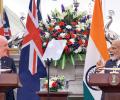
India and New Zealand have signed a pact to institutionalize their defence ties and vowed to boost cooperation in the Indo-Pacific. Prime Minister Narendra Modi raised concerns about anti-India activities by some illegal elements in New Zealand with his Kiwi counterpart Christopher Luxon. The two sides also signed six agreements to enhance cooperation in areas including education, sports, agriculture, and climate change. They also agreed to prepare a roadmap for cooperation in the defence industry sector and explore early implementation of cooperation in the digital payments sector.

Hoping to meet the indirect tax collection target this fiscal despite a negative trend in the first four months, Finance Minister Pranab Mukherjee on Tuesday ruled out tax cuts to tackle the drought faced by nearly half of the country.

'The bull market cycle ran for five years. It's the end of that cycle.' 'The next cycle is a down cycle, and in that down cycle, you will see the Sensex falling from their highs of around 68,000 to maybe 40,000-50,000 at the bottom of the cycle.'
With tax related cases mounting in various courts, government on Thursday appointed two senior counsel as Additional Solicitors General exclusively to deal with direct and indirect tax cases in Supreme Court and high courts across the country.

The central government is likely to exceed the budgeted tax collection target of Rs 22.2 trillion for the current fiscal year, led by better indirect tax mop-up, compliance measures, and recovery in most sectors following the second wave of the Covid pandemic. Personal income and corporate tax collections (net of refunds) grew 74 per cent to Rs 5.70 trillion in the first half of the current financial year, driven mainly by advance tax and TDS payments. The target for the current fiscal year is Rs 11.08 trillion; higher taxes are paid usually towards the end of a fiscal year.

The new tax is expected to subsume various indirect taxes, including excise and value-added tax.

When the Centre collects money through cess, it can retain the entire fund for the particular scheme.

Analysts believe the GST could boost India's economic growth by up to 2 percentage points
 © 2026 Rediff.com - Advertise with us - Disclaimer - Privacy Policy - Sitemap - Feedback - About us - Terms of use - Grievances